Fostering Business-IT Alignment
Fostering Business-IT Alignment over Developer-driven Process Automation
A process you automate should be a process your business can read, question, and correct.
This principle asserts that process automation succeeds when business and IT build a shared understanding of the domain, not when developers translate requirements into code on their own. We hold this because a model is only as valuable as the real-world process it represents. When the people who run the process can read the model, the model stays honest.
Alignment is not a one-time handover. It runs through the whole BPM lifecycle: a process moves from identification and discovery, through analysis and redesign, into implementation, monitoring, and controlling, and then round again. Business and IT meet at every stage, and the process model is the shared artifact that carries understanding from one stage to the next.
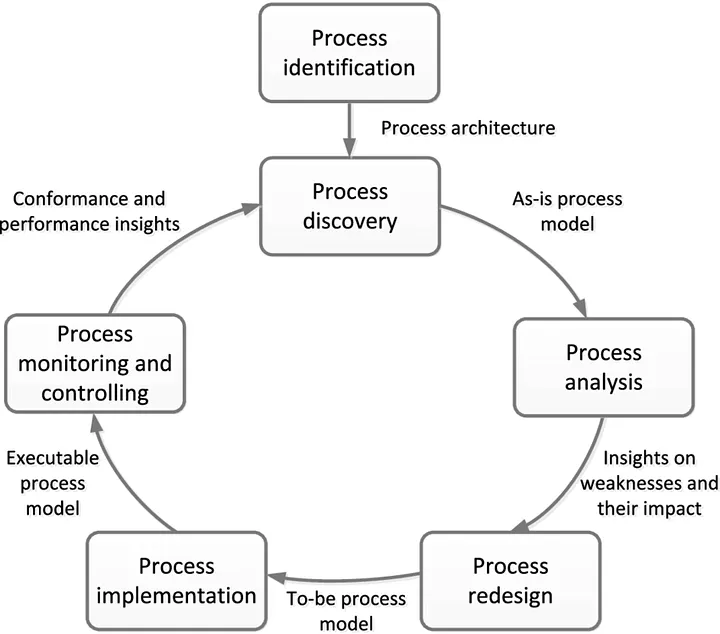
The BPM lifecycle, after Dumas, La Rosa, Mendling, and Reijers, Fundamentals of Business Process Management (Springer, 2018).
Why it matters
When your developers own a process in isolation, the running model drifts from the business it serves. Picture a claims-approval process that encodes an engineer's assumptions about escalation rules no adjuster ever confirmed. You do not see the gap until it surfaces in production as rework, workarounds, and lost trust.
BPMN (Business Process Model and Notation, the standard graphical language for process diagrams) is built to be read by non-technical stakeholders. You lose that value when your diagram fills up with technical detail. An unreadable model stops being a communication artifact and becomes an execution artifact alone: code in another shape.
The concrete costs show up again and again:
- Knowledge concentrates. Process expertise lives in one or two developers and leaves when they do.
- Stakeholders sign off on the wrong thing. They approve documents rather than the model that runs, so nobody validates what actually executes.
- Terminology diverges. "Customer" in your model means something different from "customer" to the business, which quietly breaks decision logic and reporting.
In practice
- Model together, not for. Run collaborative modeling sessions with domain experts instead of handing them a finished model to rubber-stamp. A tangible method such as t.BPM, which lays out physical BPMN tiles on a table, draws non-technical participants into the modeling and produces a model everyone has helped shape.
- Keep the top level readable. Push connectors, error handling, and expressions into subprocesses or call activities so the main diagram still tells the business story.
- Establish a ubiquitous language. Agree on one shared set of terms for tasks, roles, and data (a ubiquitous language, in domain-driven design terms), then reuse it in BPMN element names, DMN inputs, process variables, and gateway labels so every element reads the way the business speaks.
- Externalize decisions with DMN. Move business rules out of code into DMN (Decision Model and Notation) decision tables that domain experts can read and change without a deployment.
- Validate the executable model itself. Walk stakeholders through the actual deployable model in Camunda, Operaton, or Flowable, not a separate specification that drifts from it.
What this doesn't mean
This is not a call to stop writing code or to let non-technical stakeholders drive every technical decision. Developer-driven automation delivers real value: engineers bring the discipline, integration skill, and depth that make a model executable and reliable. The point is one of emphasis and sequencing: ground the work in shared domain understanding first, so the code you write automates the process the business actually runs.
Related principles
- Process Automation Best Practices: readable modeling conventions and separating orchestration from business logic keep aligned models maintainable.
- Continuous Process Improvement: shared alignment feeds the improvement loop, with the business tuning DMN tables over time.